What Is Fair Use for Images?
2026-09-07 · 8 min read
Fair use is one of the most invoked — and most misunderstood — ideas in image copyright. Ask a group of bloggers or social media managers whether they can use a particular photo, and someone will answer "it's fair use." That answer is usually wrong.
Under U.S. law, fair use is a legal doctrine, codified in Section 107 of the Copyright Act, that permits limited use of copyrighted material without permission in certain situations — typically criticism, comment, news reporting, teaching, scholarship, or research. What many people miss is that fair use is a defense, not a right. You cannot declare a use "fair" in advance; only a court can decide, and that decision comes after a dispute has already started.
This article explains how fair use for images actually works: the four factors courts weigh, how the analysis plays out in common image scenarios, and the myths that cause trouble. It is general information, not legal advice.
The Four Factors
Under U.S. law, courts apply a four-factor test drawn from Section 107 of the Copyright Act to decide whether a use is fair. No single factor controls; they are weighed together, and every case turns on its own facts.
1. Purpose and character of the use. Courts ask whether the use is commercial or nonprofit, and whether it is "transformative" — adds something new with a further purpose or different character, such as commentary, criticism, or parody, rather than repackaging the original. The statute's favored purposes (criticism, comment, news reporting, teaching, scholarship, research) lean toward fair use, while commercial use leans against it — though neither is decisive on its own.
2. Nature of the copyrighted work. Fair use applies more readily to factual works than to highly creative ones. This factor tends to cut against fair use for images, because photographs and illustrations are treated as creative expression that copyright protects strongly.
3. Amount and substantiality of the portion used. Courts look at both quantity and quality: how much was used, and whether the "heart" of the work was taken. For images this factor is awkward, because reproducing a photo usually means reproducing the whole photo, which often weighs against fair use — though courts accept that some purposes, such as thumbnail image search, require showing the entire work.
4. Effect on the potential market. Courts ask whether the use substitutes for the original or harms the market for it or for works the owner might license — frequently described as the most important factor. If an image is normally licensed — think of a stock photograph — and your use replaces a sale, this factor weighs heavily against fair use.
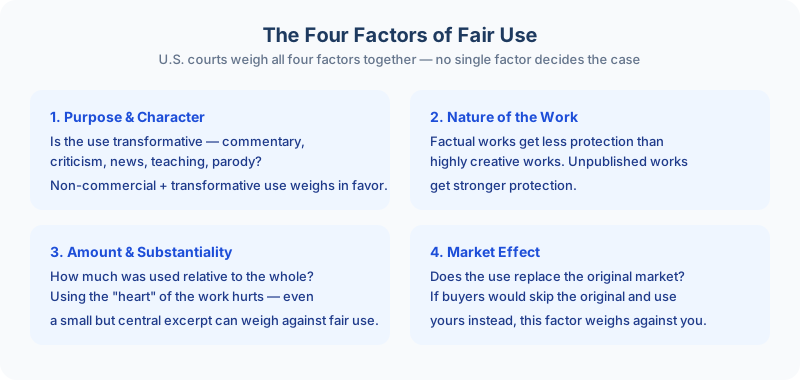
The four factors interact rather than add up: a strongly transformative purpose can outweigh other factors, and a weak purpose can sink a case even when the amount used was small. For the statutory text and the Office's fair use index, see the U.S. Copyright Office fair use page. Before you reach the fair use question, though, confirm the image is protected and who owns it — see our guide on how to check image copyright.
Fair Use for Images in Practice
The best way to understand the doctrine is to see how the four factors apply to common image scenarios. What follows describes what courts consider — not the outcome of any specific case.
Using an image in a review or commentary article. Reproducing a photograph or artwork so readers can see the exact thing you are criticizing is the classic fair use scenario under U.S. law. If your article analyzes the image itself — its composition, its meaning, the controversy around it — the purpose factor leans strongly in your favor. But the other factors still matter: you have probably used the entire image, and if it is available for licensing and your commercial article draws significant traffic, the market-effect factor may weigh against you. If you plan to analyze an image, first trace it to its source — see our guide on how to reverse image search.
Images in classroom teaching materials. Teaching is one of the purposes named in the statute, and nonprofit educational use tends to help the purpose and market-effect factors. That is not a free pass: showing an image in a face-to-face classroom is very different from posting it on a public course website, and educational publishers do license images, so there may be a market to harm. Nonprofit use improves the analysis; it does not end it.
Using a news photograph in a news article. News reporting is also named in the statute, and using a newsworthy image to illustrate the very story it depicts can support fair use. But courts look closely at whether the image is itself the subject of the news — as with paparazzi photographs or viral images — and newsrooms still routinely license photographs for ordinary illustration. "Newsworthy" does not mean free to use.
Memes, reaction images, and social posts. Repurposing an image for humor or commentary can be transformative, and courts have sided with creators in some meme and parody cases — and ruled the other way where the use simply borrowed an image's appeal without adding commentary. "It became a meme" is the beginning of an analysis, not an argument.
If the analysis feels uncertain, remember you can sidestep it entirely by using images with clear licenses — see our guide to free image sources — or by getting the basics of image copyright straight before you publish.
Common Fair Use Myths
Myth: nonprofit use is automatically fair use. Nonprofit status helps the first and fourth factors, but it is not decisive. Courts have found against nonprofits that reproduced entire works in ways that replaced a market, and for commercial defendants whose use was highly transformative. The question is never simply "was money involved?"
Myth: giving credit makes it fair use. Attribution is good practice and may matter for other reasons, but it does not change the fair use analysis under U.S. law. Crediting a photographer does not turn an unlicensed reproduction into a fair one.
Myth: changing 10% or 30% of an image makes it fair. There is no percentage rule anywhere in U.S. copyright law. Courts weigh what was taken qualitatively, not by counting pixels. Cropping, flipping, filtering, or lightly editing a photograph almost never transforms it enough to change the analysis, and the alterations may simply count as derivative works.
Myth: if an image is freely viewable online, using it is fair. The internet is a distribution channel, not a license. Public access has nothing to do with fair use, and "free to view" is not the same as "free to use" — see what can happen when you use a copyrighted image.
Fair Use Outside the U.S.
Fair use is a doctrine of U.S. law, and it does not travel. Other jurisdictions handle unauthorized use differently:
- United Kingdom and other Commonwealth countries apply "fair dealing," which is narrower: only a closed list of purposes — research, criticism, review, news reporting — can qualify, no matter how fair other uses seem.
- The European Union harmonizes specific exceptions through its copyright directive — including quotation, parody, and education — but member states implement them differently, and there is no general open-ended fair use rule.
- Some countries have no flexible exception at all, leaving unauthorized use to narrow statutory exceptions.
Because copyright is territorial, a use that is defensible as fair use in the United States may be infringement elsewhere. If your audience crosses borders, plan against the strictest applicable regime.
When to Get Real Legal Help
Fair use outcomes are hard to predict even for lawyers: courts have reached opposite results on similar facts. Certain signals make professional advice especially worthwhile:
- Your use is commercial and the image is central to your product or content.
- Your publication has significant traffic or revenue.
- You are reproducing an entire image without transformative commentary.
- The image belongs to a stock agency or creator with a known licensing program — an obvious market you may be harming.
- You have received a takedown notice, a demand letter, or a platform strike.
In these situations, a qualified copyright attorney can review the facts and give you a real risk assessment — far cheaper than defending a claim later. This article is general information, not legal advice.
Know What You're Working With Before You Publish
Fair use is a balancing test, not a checklist — and the surest way to avoid the balancing act is to understand your images before you publish. The image copyright checker analyzes any image you upload, traces its sources, and flags potential copyright concerns, so you can decide in minutes instead of guessing. New users get 3 free checks on sign in.