Image Copyright Basics Every Creator Should Know
2026-07-20 · 7 min read
Copyright law can feel overwhelming, but understanding the basics will help you avoid costly mistakes. This guide covers the fundamentals every content creator needs to know: how copyright protection arises, what the most common image licenses allow, when fair use applies, and which widely repeated myths you should ignore.
What Is Copyright?
Under U.S. law, copyright is a set of exclusive rights granted to the creator of an original work, including the right to reproduce, distribute, publicly display, and create derivative works. For images, protection is automatic: the moment someone takes a photograph or finishes a drawing, the work is protected. No registration, publication, or copyright notice is required, although registration with the U.S. Copyright Office unlocks additional legal remedies, discussed later in this guide.
Protection generally lasts for the life of the author plus 70 years, though the term differs for works made for hire and for older works. One point that surprises many people: the person who owns the copyright is not always the person in the picture. A photographer or their employer usually owns a photo even when you are the subject, which is why permission from the photographer is what matters when you want to reuse it.
Common Image Licenses Explained
Using an image legally requires either a license from the rights holder or a legal exception such as fair use. The sections below cover the license types you will encounter most often.
All Rights Reserved
This is the default copyright status. The creator retains all rights, and you cannot use, modify, or distribute the image without explicit permission. Most images you find on the web fall into this category, including nearly everything on social media and on paid stock photography sites.
Creative Commons (CC)
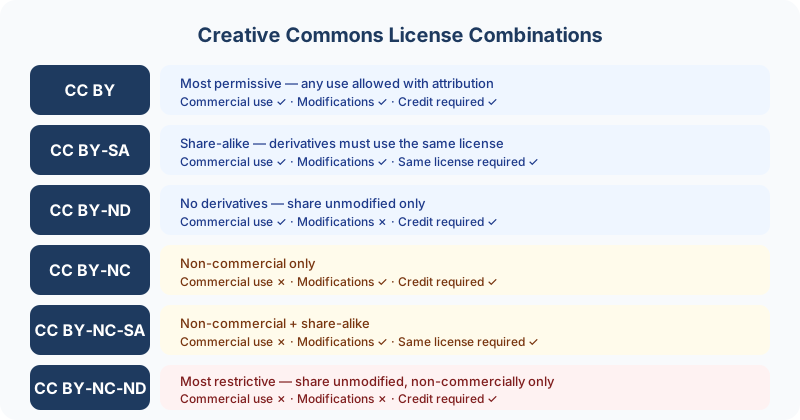
Creative Commons is a nonprofit organization that publishes standardized licenses, letting creators grant specific usage rights in advance while keeping their copyright. The licenses are built from four conditions: BY (attribution required), NC (non-commercial use only), ND (no derivative works), and SA (share alike, meaning adaptations must carry the same license). Those conditions combine into six licenses, from most to least permissive:
- CC BY — The most flexible license. You may use, modify, and even sell the work commercially, as long as you credit the creator.
- CC BY-SA — Commercial use and adaptation are allowed, but any derivative work you share must be published under the same CC BY-SA license, keeping the work open.
- CC BY-ND — You may share verbatim copies, including commercially, with attribution, but you may not remix or adapt the work.
- CC BY-NC — You may adapt the work and share your version, with attribution, but commercial use is not allowed.
- CC BY-NC-SA — Attribution is required, commercial use is forbidden, and any adaptation must be released under the same license.
- CC BY-NC-ND — The most restrictive. You may download and share the work unchanged with credit, but you may not modify it or use it commercially.
The license deeds on the Creative Commons website spell out each condition in plain language, so it is worth checking the deed for a work rather than relying on a thumbnail caption when you are unsure.
CC0 / Public Domain
With a CC0 dedication, the creator waives all rights to the extent the law allows. You can use, modify, and distribute the work freely, even for commercial purposes, without attribution. Works also enter the public domain once copyright expires: under current U.S. rules, most works published 95 years ago or earlier are now in the public domain.
Royalty-Free
This term is widely misunderstood. Royalty-free does not mean the image is free of charge. It means you pay for a license once and can then use the image multiple times without paying additional royalties per use. The initial purchase price still applies, and usage restrictions in the license still bind you.
What Is Fair Use?
Fair use is a legal doctrine under U.S. law that permits limited use of copyrighted material without permission for purposes such as criticism, commentary, news reporting, teaching, scholarship, and research. It is not a blanket category: courts decide whether a particular use qualifies on a case-by-case basis by weighing four factors:
- The purpose and character of the use, including whether it is commercial or transformative
- The nature of the copyrighted work
- The amount and substantiality of the portion used in relation to the whole work
- The effect of the use on the potential market for or value of the original
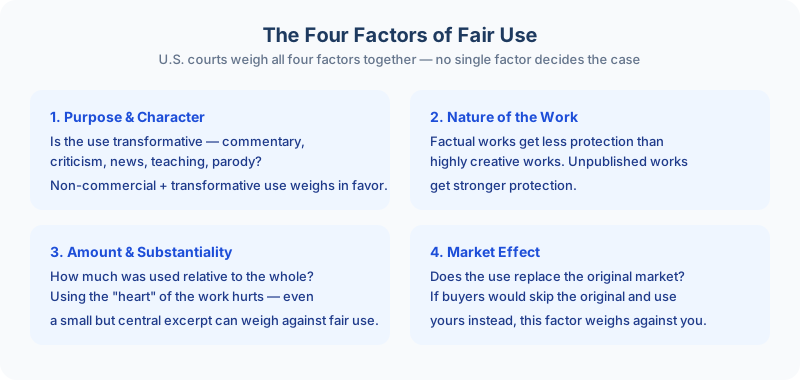
No single factor is decisive. Courts weigh all four together, so a use can score well on one factor and still fail overall. Fair use is also a legal defense, not a right: you assert it only after being challenged, and it is never safe to assume your use qualifies without advice from a legal professional.
How to Register a Copyright
Registration is not required for protection, but it gives rights holders meaningful advantages under U.S. law. To register, you submit an application, a filing fee, and a copy of the work through the electronic registration system (eCO) at copyright.gov. Fees currently range from about $45 to $65 depending on the application type.
Why register? For U.S. works, registration is a prerequisite before you can file an infringement lawsuit. If you register before an infringement occurs, or within three months of first publication, you become eligible for statutory damages (up to $30,000 per work, rising to $150,000 for willful infringement) and an award of attorney's fees. Without those remedies, a successful plaintiff is often limited to actual damages, which can be difficult to prove. Registration also creates a public record and, when made within five years of publication, serves as evidence of the copyright's validity in court.
Common Copyright Myths
Misinformation about copyright spreads fast. Here are five common myths and the reality behind them:
- "There's no © symbol, so it's free to use." Under U.S. law, a copyright notice has been optional since 1989. Protection applies automatically from the moment a work is created, symbol or not.
- "If I give credit, it's legal." Attribution is good practice, but it is not a substitute for permission. Crediting the creator does not change the fact that you used a work without a license.
- "If I change it by 10 percent (or any fixed amount), it becomes mine." There is no percentage rule in copyright law. Edits and adaptations are derivative works that still require the original creator's permission.
- "Everything on Google Images and Pinterest is free to use." Search engines and social platforms index images; they do not license them. An image's availability online says nothing about its copyright status.
- "Nonprofit and educational use is automatically fair use." Noncommercial, educational purposes weigh in favor of fair use, but they do not guarantee it. Courts still examine all four factors, including the effect on the market for the original.
Best Practices for Creators
- Verify the source first. Before you publish, spend a few minutes checking an image's copyright to find where it originated and who holds the rights.
- Read the license terms. Do not assume "free" means "free for commercial use." Check the actual license, including whether attribution is required.
- Prefer clearly licensed sources. When possible, choose from free image sources with safe licenses such as CC0 collections, which remove most of the guesswork.
- Keep records. Save screenshots of license terms and attribution pages when you download images.
- When in doubt, don't use it. The risk of a takedown or an infringement claim is rarely worth the cost of using a questionable image.
How Technology Can Help
Modern AI-powered tools can analyze an image and identify its original sources, helping you understand the copyright landscape before you publish. Consider using a copyright checker as part of your content workflow, or start with reverse image search to trace where an image first appeared.